home » stories » by mesearch within stories
Family Stories
A potpourri of stories about various family members or events
How NOT to clean a cast iron pan
I had my first four years of elementary school (grades 1-4) when we lived in St. Cloud (MN). During either second or third grade, I became good friends with a schoolmate named Joel. While we didn’t ride the same bus together, we did live on the same road. If one were to go south on the road that ran past my home, cross U.S. Highway 10, and keep going, one would run into Long Lake. My friend lived on that lake, adjacent to the road.
Some time in the summer after third grade (though it could have been second), we decided to have a sleepover at his place. On a previous visit, I had stayed over in the winter, and I remember that for breakfast, I had my first encounter with a poached egg. I wasn't keen on it, but I ate it without reservation. Since it was summer, instead of sleeping inside, Joel had the idea of tenting outside. And if we were sleeping out, we might add some adventure to it. So we decided to sleep on the shore of Round Lake, an adjacent lake that we could reach from his home through a channel.
We got all of our supplies into one of their boats and headed over to the neighboring lake. He was able and allowed to use a motor, and that impressed me. We set up our tent, had a fire that night, and likely told stories, but eventually went to bed and slept. We then woke up early and started a fire to cook some eggs. (In hindsight, I can't believe we thought about bringing a cooler for these eggs, but maybe it was less necessary then. I don't think we made a trip back in the morning.) We had a cast-iron pan with which to make our scrambled eggs, and we had fun making them and then eating them. Thinking ahead to when we would need to clean the plan, I remembered how sometimes, when our family camped, we would use a nearby lake or river to help pre-clean our cooking pots or utensils. Since we were on the shore of the lake, I proudly volunteered to help clean out the pan. He had provided most of the supplies, so the least I could do was to help with the cleanup. (Our pan was NOT as clean as what is shown below.)
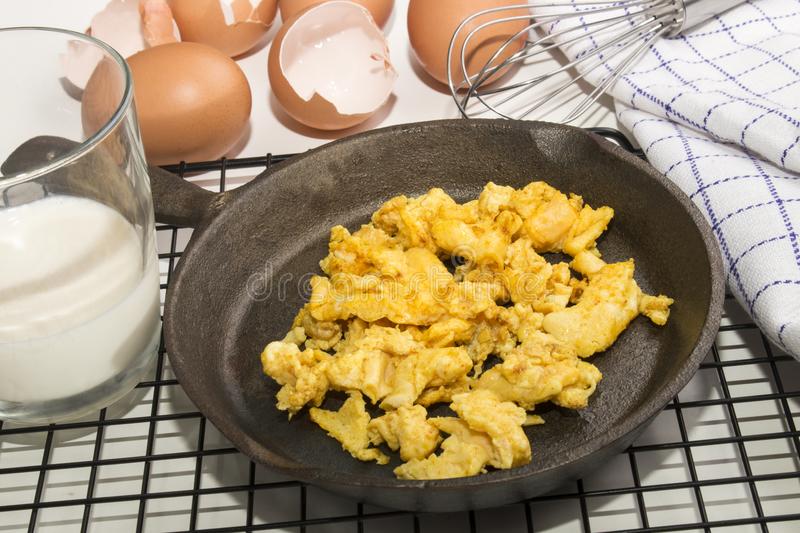
I grabbed the mitt that we used to handle the hot cast-iron pan and used it to help transport the pan to the lake. I knew that there was some clean sand right on the shoreline and that I could use that as an abrasive to help clean out the pan. When I got to the edge of the lake, I lightly dropped the pan into the lake and was wondering how much the water would warm up as it transferred the heat. I learned a lesson in physics, economics, and cooking: a hot cast-iron pan after meeting cold water will need to be replaced since the brittleness of the pan can not endure the temperature differential, and this causes the pan to crack. I unintentionally and unknowingly created thermal shock. You have likely seen this before if you added very cold ice cubes to some warmer water: you will hear some cracks and maybe see where they occurred. The same thing happened to the pan.
I apologized to Joel's mother and tried to explain that I was trying to help, and she simply told me that this kind of pan needs to cool down before it can be cleaned, as I was about to do. I am sure she was disappointed, but she didn't yell at me. Now, as an adult, I know that I should have offered to pay for it or told my parents so that they could. And I was invited back again the following winter. There is an interesting story associated with that visit (to be told sometime in the future). Just because I have never since placed a hot cast iron pan into cold water does not mean I completely learned my lesson; there is another related story to be told sometime.
Published 2021-06-09. Revised 2025-08-12.
If you find any error(s) in the text, please let me know. Thanks. Contact me with errors or comments using hibbardac@gmail. [Back to the top] [About the author, Al]
Do you weigh us before and afterwards?listing of family stories by me Sesquicentennial of the Hibbard-Westurn Arrival