home » stories » by others » by Jesse Hibbardsearch within stories
Family Stories
A potpourri of stories about various family members or events, written by others and edited by me.
Howard H. Hibbard's 1875 Account Book
[This is an item that my grandfather Jesse Hibbard wrote in it some time after his mother died (1947). This book was initially my great-grandfather's (Howard Horatio Hibbard, Jesse's father) journal book. As can be seen on the first page, it was purchased on 1 Nov 1875, exactly one year before he married Rose Ann Doran. Howard used about the first 15 pages, but then ripped them out some time before his death (or perhaps his wife ripped them out). Jesse expressed regret for this loss. He used the book to record memories of his father, and their parents, as well as some about his mother and her family. My (Al) role was to first transcribe it, next to add corrections or clarifications [within brackets], and then to add links to people connected to me (that gives more information), links to give more information about places, and for those mentioned but not connected, I sometimes added links to FamilySearch.org.]
Images (skip to transcription)
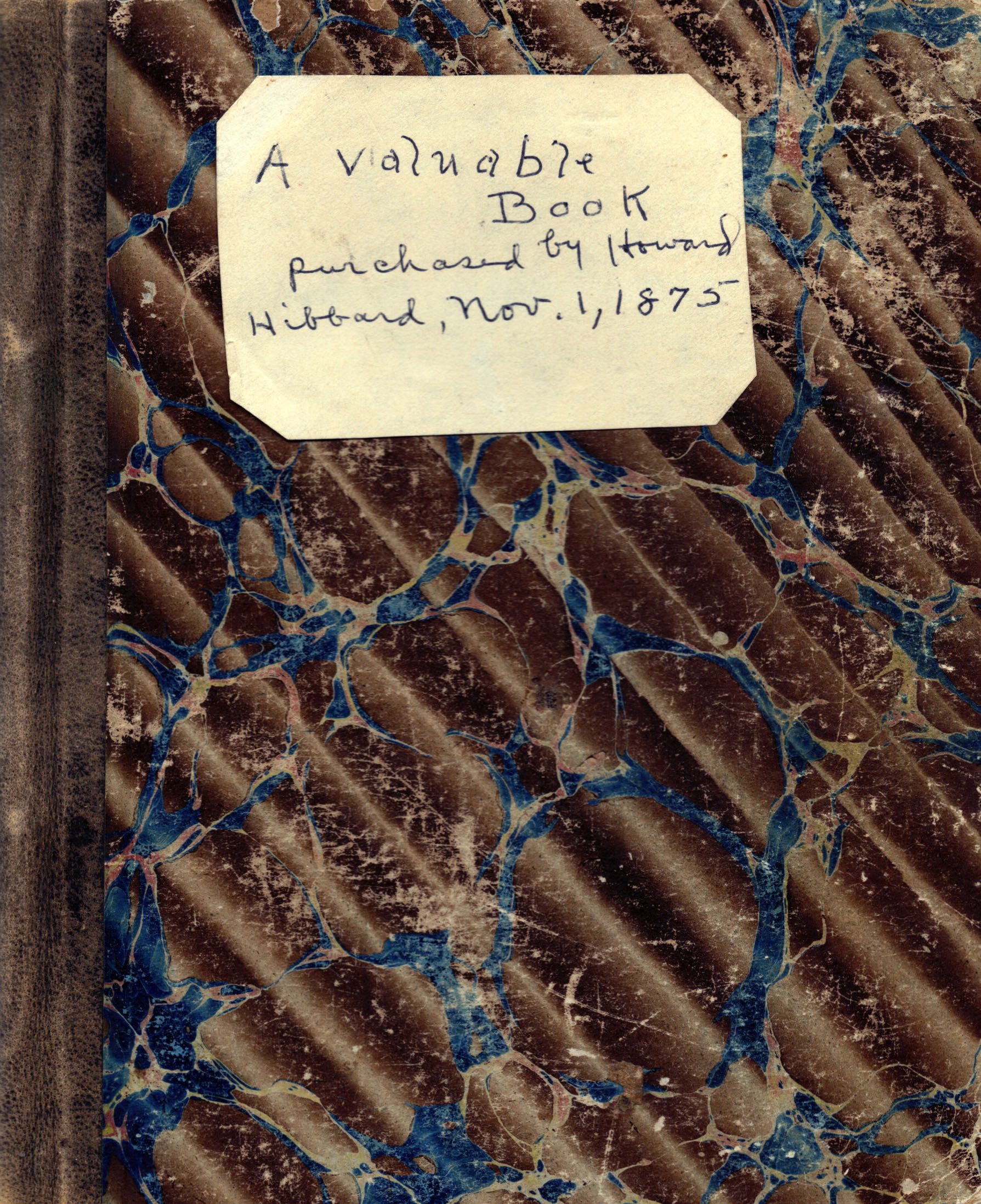
Front cover of the book
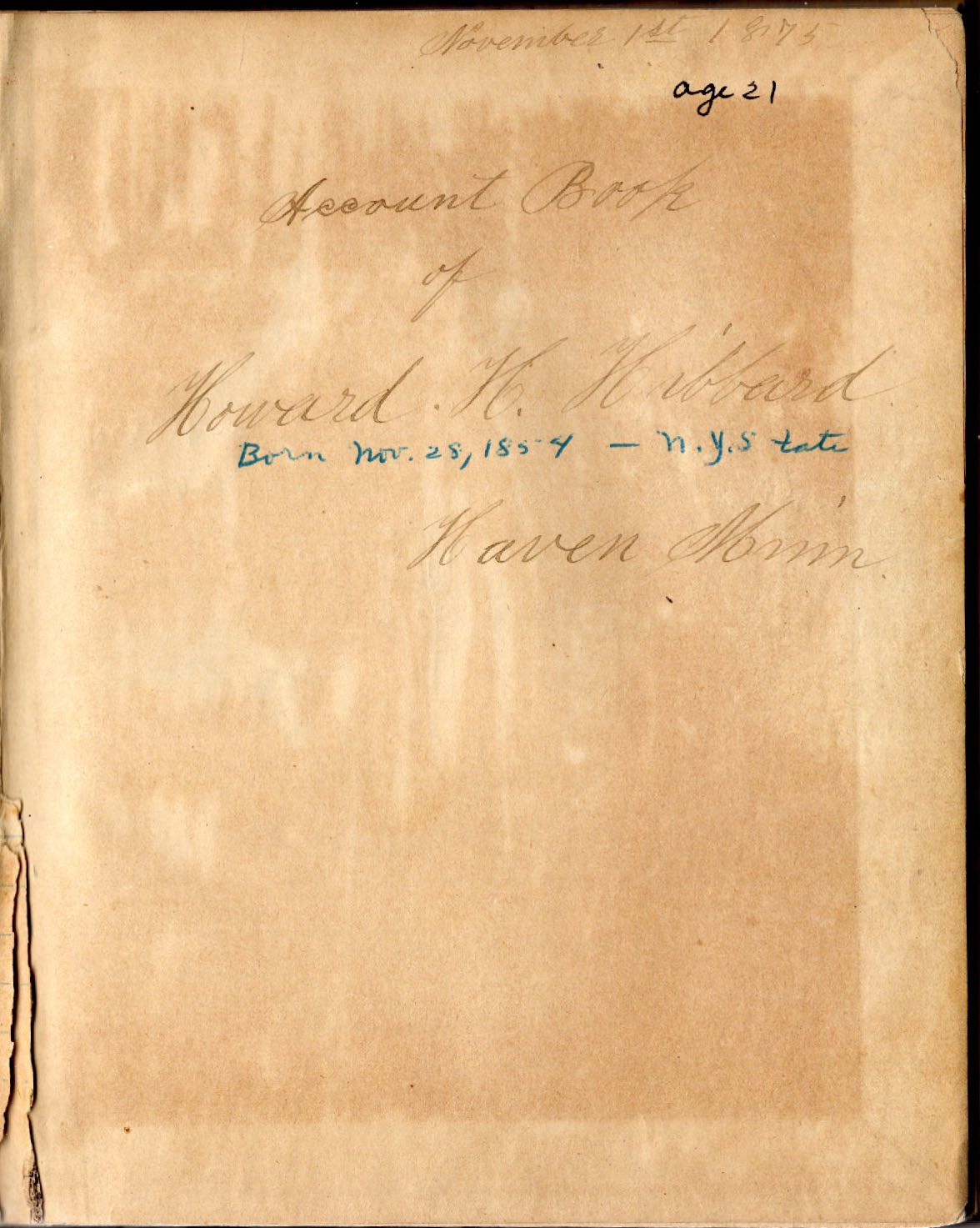
Title page of the book
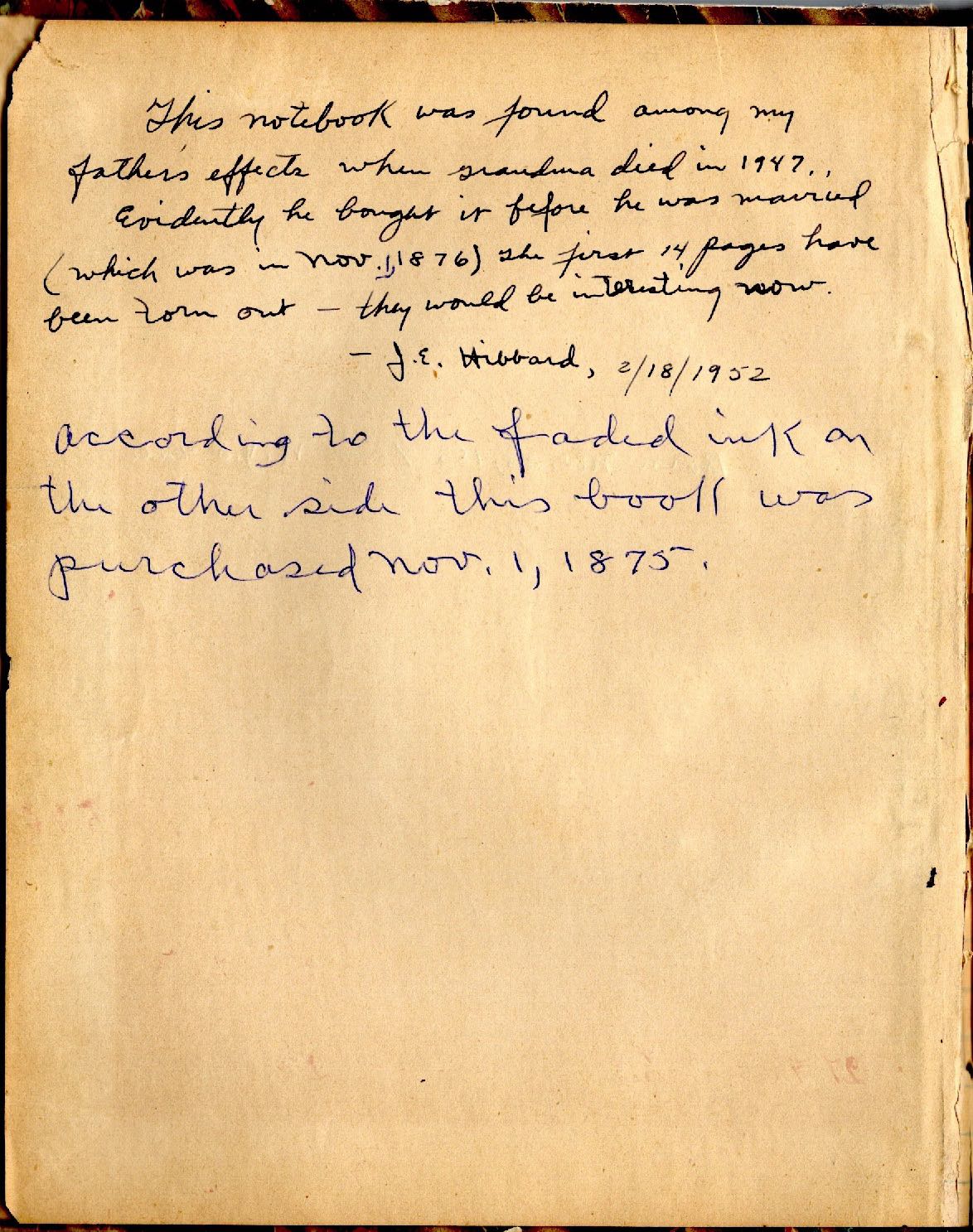
Jesse Hibbard forward
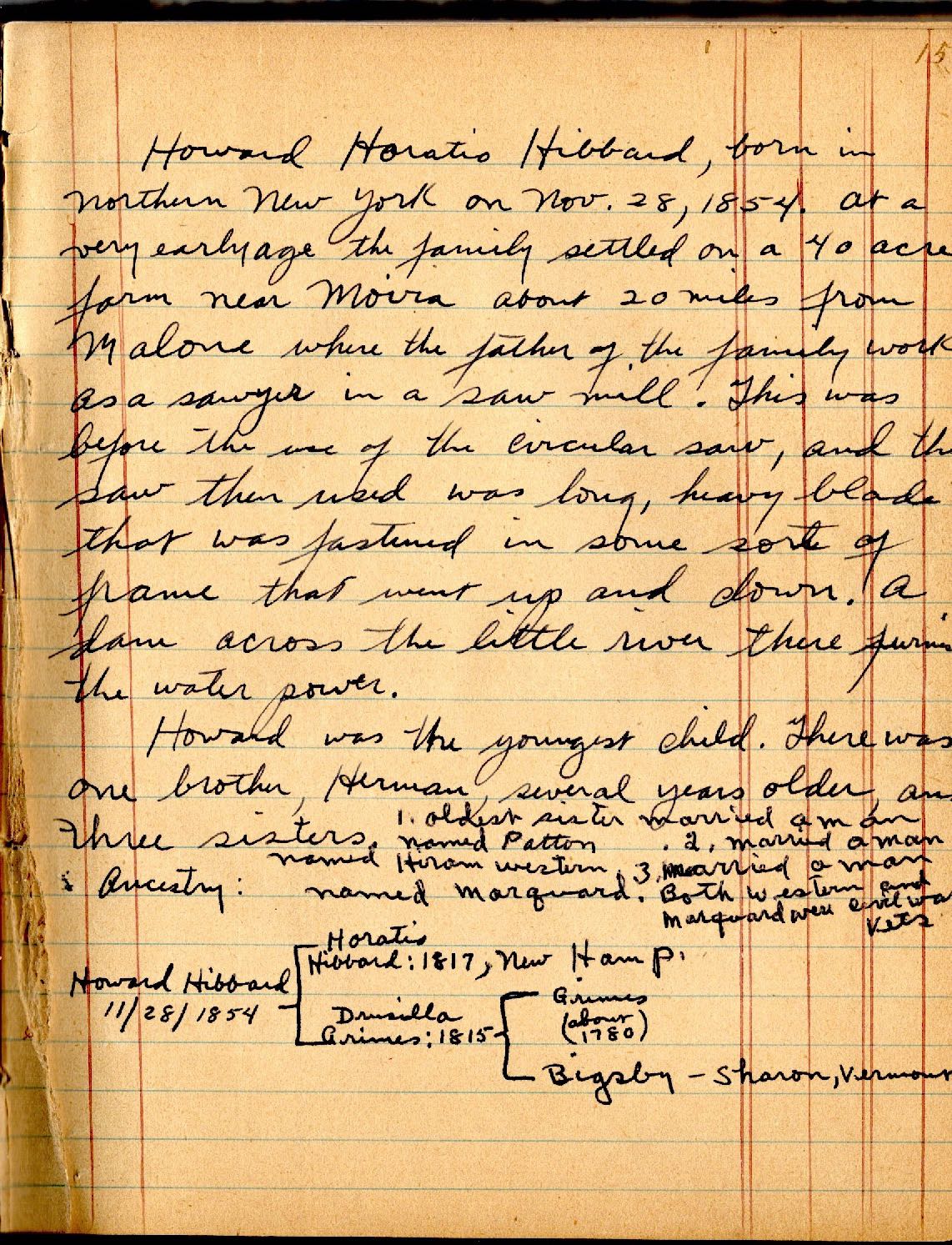
page 15, starting page of the narrative
Here are links to the remaining pages, whose form is similar to the last page shown. In the images, the page number was (handwritten by Jesse?) in the top left or right corner, depending if the left or right side of the book.
page 16 page 17 page 18 page 19 page 20 page 21 page 22 page 23 page 24 page 25 page 26 page 27 page 28 page 29 page 30 page 31 page 32 page 33
Transcription
Note that text written in darkcyan text below seems to be written by Howard Horatio Hibbard (but not much, in my opinion), while the rest seems to be done by his son Jesse Edmund Hibbard. At first I (Al) thought that part of the narrative was written by Howard, but that was an awkward read (since he would have been using the third person - which is ok, and referred to his parents as grandpa - which is also ok, but reading it several times it just seems to be Jesse's writing).
This document recounts a number stories. I have transcribed all the pages in this book. I have chosen many of the stories and list them below with very brief summary and then a link to that specific story. You are encouraged to read the whole document, but if you wish to come back for a specific story, this might be helpful. Note that (x¶) suggests that you read x paragraphs for the whole story.
If you are short on time and just want to sample the "best", check out those preceded by **. If you have more time, I think those with * are also intersting for other reasons. Of course, I think it is all interesting. In total, if the transcription was printed out in entirety, it is about 6 pages.
- ** Jesse's grandmother, at age seven, is sent to grist mill
- Herman visits his grandmother's family in Sharon
- Jesse's great grandparents hated the English
- Horatio hikes to Montreal
- * Early Hibbard family life in northern NY
- * Drusilla loved tea and her boys helped get it
- ** Howard sees lesson to financially plan his life (2¶)
- Howard gets a closer look at a horse than desired
- ** Howard's favorite story, regarding gingerbread
- Horatio liked his tobacco, but Howard didn't
- Howard target practicing on head lice
- * Harvesting maple syrup (3¶)
- * Howard soured on lending
- Crazy woman screaming
- Drusilla's stories (2¶ + next entry)
- ** Drusilla's story about the man found wearing two pairs of pants
- Rose - information
- Rose's father - information
- Rose's step-siblings
- Rose's sister Margaret (3¶)
- Rose's sister Kate plus West Point Ralph
- Rose's time with Mulligan aunt and uncle
- Rose + Howard married and homes (2¶)
- Hibbards move from NY to MN
- Jesse recalls history of harvesting wheat (5¶)
Cover
Title Page
November 1st 1875
age 21
Account Book
of
Howard H. Hibbard
Born Nov. 28, 1854 - N.Y. State
Haven Minn
Jesse Hibbard forward
This notebook was found among my father's effects when grandma died in 1947.
Evidently he bought it before he was married (which was in Nov. 1, 1876). The first 14 pages have been torn out - they would be interesting now.
- J. E. Hibbard 2/18/1952
According to the faded ink on the other side this book was purchased Nov. 1, 1875.
Pages 15--33
[The content below is found on pages 15 to 33, starting with p.15. I will insert "[p.x]" where the next page starts (page x) and there will be a link to that page, in case you wish to view the image of that particular page.]
Howard Horatio Hibbard, born in Northern New York [likely Stockholm Township in St. Lawrence County] on Nov. 28, 1854. At a very early age [abt 7] the family settled on a 40 acre farm near Moira about 20 miles from Malone where the father of the family worked as a sawyer in a saw mill. This was before the use of the circular saw, and the saw then used was long, heavy blade that was fastened in some sort of frame that went up and down. A dam across the little river [Salmon River] there furnished the water power.
Howard was the youngest child. There was one brother, Herman, several [6] years older, and three sisters. 1. oldest sister [Thirza Jane] married a man named Patton [Hiram Rowley Westurn]. 2. [Mary Melissa] married a man named Hiram [Joseph Warren] Westurn. 3. [Emily Druzilla] married a man named Marquard [Harmon Henry Marquit]. Both Westurn and Marquard were civil war vets [all three were]
[Family Tree graph, starting with Howard Hibbard 11/28/1854. Then up to father Horatio Hibbard: 1817, New Hamp.; down to Drusilla Grimes: 1815; from her, up to father Grimes (about 1780) and down to mother Bigsby [Hunter?] - Sharon, Vermont]
[p.16] It has been suggested that I write down some of the things that I remember; tales that my pa [Howard] told me long ago.
When Grandma Drusilla was seven years old and living near Sharon, Vermont (this would have been in 1822) her pa sent her to the local grist mill to get some corn ground. A sack was filled perhaps a little less than half full, tied securely, the shelled corn evenly distributed to each end and balanced on the bare back of an old horse with the little girl sitting on behind. On this summer afternoon a thunder storm came up, but Drusilla was nearly arrived at the mill before the rain came, and then it rained so long and so hard that night came and the miller made the little girl stay all night not only because of the darkness, but because of the flash floods that came down the ravines between the hills and made travel over the mountain trails impossible for a few hours.
[p.17] The part of this story that pa used to marvel about was his mother's claim that her family weren't worried about her not coming home until morning.
[back to index of stories]
Sometime in the sixties Herman went back to Sharon and visited with his maternal grandmother's family, the Bigsbys, of whom there seemed to be quite a clan and returned to [New] York state with tales of the nice farms they had.
[back to index of stories]
My grandparents parents were probably born during the Revolution but there doesn't seem to be any definite information available. All pa knew was that his folks grew up with a great hatred for the English; this must have resulted from talk overheard when they were young. [This is surprising because, on paper, it appears that the Hibbards aligned with the Loyalists, and so friendly toward the English.]
[back to index of stories]
Grandpa Horatio Hibbard was born somewhere in New Hampshire in 1817 [or Brome area of Quebec since he was baptized there 7 months after birth]. The biggest event in his life seems to have been the summer when he was [p.18] eighteen, probably summer of 1835. He wanted to see a city so he started out in the spring with his rifle for baggage, went over to Lake Champlain, and followed it north, working a little for settler when opportunties offered or eating wild meat. Anyhow he finally got Montreal and returned before winter -- six or seven months. From what my mother told me of old Horatio [Horatio Hiram] he never was in a hurry, anyhow.
[back to index of stories]
When Horatio and Drusilla got married they hiked over into Northern New York [settling in Stockholm] with what they could carry and Horatio worked in saw mills. When Howard could first remember they had moved to a little farm about two or three miles from Moira. His Pa worked in the mill and the family lived on the 40 acre farm nearby. [I have visited that location - Al] They had a team of horses (which meant some affluence in those days, as the very poor had only oxen). They had some cattle, chickens (no hogs) and a dozen sheep [p.19] which clothed them. Drusilla washed the wool, spun the yarn, and with her children's help wove cloth for the men's clothes - besides churning butter. Also when the boys wanted fish lines Drusilla wove them out of horse tail hairs. For a 112 lb. 5'2" hillbilly Drusilla seems to have been a very capable girl.
[back to index of stories]
She loved the tea and when during the war between the states tea became very expensive because of high tariffs or else unavailable for some other reason her boys would go for a long walk across into Quebec to buy tea and return after dark far enough from main roads to avoid the Border Patrol.
[back to index of stories]
One story pa used to tell was of a snowy blustery Nov. Saturday when he [Howard] was nine. That would have been the fall after Gettysburg [which was November 19, 1863 and Howard was almost 10 in 1864 before his birthday]. He [Howard] was walking into Moira to buy something for his [p.20] mother and a neighboring farmer with his horse and buggy picked Howard up and gave him a ride to town. As they entered the village a white-bearded old man was sawing wood with a buck saw out behind one of the better homes. Every one knew him. That was 3/4 of a century before old age pensions and this old man eked out a precarious existence with odd jobs.
"See that old guy," the old farmer said to the little boy, "young man, so plan your life so that when you are as old as he is you won't be in the condition he is in" (financially). And the little boy never forgot.
[back to index of stories]
There were other stories he told of Chatauqua [sic, Chautauqua] meetings and camp meetings or perhaps County Fairs. I'm not sure now about the latter. Anyhow the boys would take in these affairs for two or three days, [p.21] travelling with horses and wagons. There was a long shed for stabling the horses on the grounds and they [people] would sleep in the hay. On one occasion he slept in the manger and woke up in the morning by the horses front feet. Guess it wasn't much of a manger.
[back to index of stories]
His favorite story of these meetings was concerning a young man and his girl friend from back of beyond. The barker at a concession stand was advertising his gingerbread "All you can eat for a nickel." The young man went up and bought a hunk, went back and sat down on the bench by the girl, took a few bites, and remarked, "Pretty good gingerbread, Sally. Why don't you go buy yourself some?" [Did Horatio like the story because the boy didn't think about giving the girl a taste, or thinking he should have bought it for her, or thinking that the boy should exploit the All You Can Eat and just share his with the girl and then go get more. Thoughts?]
[back to index of stories]
Old Horatio raised his own tobacco and smoked a lot. Young Howard had a tendency toward asthma and [p.22] couldn't stand tobacco smoke, so he would go out in the pasture or woodlot and play in the forest evenings. In summer he fished for trout in the mill stream brook and in the winter set snares for cottontails and ruffed grouse. He would bend over a small tree as a spring for the snare and set the noose in a rabbit path. Sometimes grouse followed rabbit paths. These people from the east always referred to ruffed grouse as "partridges."
[back to index of stories]
Sometimes he would reminisce on evenings spent sliding down hill in the moonlight, and again on happenings at the country school. One story had to do with a French-Canadian girl who had moved in from Quebec. She sat in front of Howard and when the sun shone on the parting of the back of her head, he amused himself snapping bits of plaster from a hole in the wall at the head lice that played in the sun.
[back to index of stories]
One thing he would talk about nearly every spring was maple syrup [p.23] and maple sugar making as they used to do it "back in York State".
It seems they had about 200 maple trees on their farm and 200 wooden pails made especially for the gathering of sap. These pails had one long stave sticking up with a hole in it for a handle. They gathered sap in the early spring and hauled it in a barrel on a stone boat to a shanty equipped to boil it down first to syrup (about 25 to 1) then more boiling for that portion which they desired for sugar for the family's yearly supply.
[back to index of stories]
It seems that one spring after they got done a neighbor borrowed their pails, and after he got thru left them out in the sun for a couple months so that they shrunk and a lot of them fell to pieces - an event which soured Howard for life on the folly of lending.
[back to index of stories]
[p.24] Another story Howard told was of a long trip to the south which they took one Sunday with the horses into the foothills of the Adirondacks.
One winter in the area the farmers heard what they thought was a lost or crazy woman screaming in a swamp and some of the neighbors thought a search party should be formed to look for her. However, a couple of neighbor boys shot a cougar about that time and they heard no more screaming in the night. Howard and some of the other boys at school walked down the road one noon to see the cougar stretched out, frozen, on these people's porch. He said it was yellowish tan and about four feet long. (This story about a cougar that screamed seems to conflict with statements I have read that these animals are mute.) [parenthetical written by Jesse]
[back to index of stories]
One time Howard went to visit [p.25] a married sister and while there got the thrill of his life out fishing with a 13 year old Indian boy on a windy day on the St. Lawrence, near St. Regis.
My pa also told me stories his mother ^{born 1815} told him of her life at home on the farm near Sharon, Vt.
It seems they had a very large barn with a good plank floor in the drive way. In the late summer they would haul in the wheat shocks and pile the the bundles up to the roof in the barn, then in the fall an old man who made his living flailing out wheat for the farmers came around and spent weeks threshing out wheat. I wish I knew how much he was paid, but I do not. A dollar a day was considered a very good wage in those days. My grandpa started in the saw mill he first got [p.26] married for 50 cents a day, then finally after a couple years got up to a dollar a day which was top in those days.
[back to index of stories]
My grandma (according to my pa - she died before I was born) used to tell another story concerning one of the old guys who went around flailing out wheat for the farmers. He seemed to be more prosperous than the others and it was finally discovered that he wore two pairs of pants. He tied the bottoms of the inner pair at the ankles, put a gallon or so of wheat in each leg, then he wore a much larger pair over the inner pair. Since wheat was worth real money those days, I think $3.00 a bu[shel], but I have no way of varifying [sic] that figure, a 1/4 bu. a day over several [p.27] months added up.
[back to index of stories]
A little history concerning my mother who was born Jan. 20, 1857 at Haver [sic, Havre] de Grace, Maryland. Her parents came from Ireland when they were real young, the mother, Margaret [Bridget] Guthrie [last name added later], from County Clare, the father from Kildare. My mother - maiden name was Rose Ann Doran - was the middle of 5 girls [actually, 2nd]. Once she was 88 and living alone on 5th Ave - my dad died in Nov. 1932 she got to talking about her childhood and remembered that her mother died when she was 6 [actually, 8] but when her mother was still alive she had two black girls to help take care of the kids.
[back to index of stories]
I gather that my maternal grandpa, Hugh [William] Doran, was [p.28] something of a play boy. He owned a small grocery store but my mother remembered him as a deputy sheriff and a bag pipe player in the band. He was always practising [sic] on this bag pipe at home and drove the kids nuts.
[back to index of stories]
It seems he acquired a new young second [fourth] wife shortly [actually 17 years later] after the kids' mother died and she raised a boy and a girl, Wm. Doran and a Mrs. Quinn [Anna Doran Flynn], both of Philadelphia (in the 1930's). [Wm lived in Philadelphia, but Anna lived in Wilmington all her life.]
[back to index of stories]
My mother's youngest [second youngest, not counting Anna] sister, Margaret, came to the midwest in the 1880's [at Elk River at least by 1885] and spent many years as an old maid postal employee. Eventually s he married a very wealthy man in a small town in N.D., Sheldon.
Once when I was in H.S., about 1911 she stopped to visit my mother in [p.29] St. Cloud. ^{Her husband's name was Ed Pierce} [added later] She had a Pierce Arrow with a chaffeur [sic] - on their way to Florida for the winter.
After the depression [actually, he died in 1927], he was worth less than 4 million, but when she died ^{1950}, a long time after her husband, she left about 3 3/4 million, mostly to his nephews, and a little to her sister's kids in the St. Cloud area (about 1950) [10 Dec 1948].
[back to index of stories]
Another sister, Kate, used to write to me up until she died in about 1943 [27 Dec 1942 - spot on]. She told of a nephew, Ralph, forgot his last name, he was a son [grandson] of my oldest aunt [Mary Ellen Doran Comegys], he graduated from West Point about 1914 and for many years was a foot ball coach at West Point. During the 2nd [1st] World War he went over seas as a Col. of Artillery.
[back to index of stories]
[p.30] Feb. 20, 1978
When my mother was 10 she went to live with her father's sister and husband, Mr. and Mrs. Hugh Mulligan. They left shortly for Calif. via Panama. They took a steamer from Philadelphia to Panama (somewhere in Central Amer if not Panama) [actually, I think Rose Ann took the steamer from Philadelphia to St. Louis and then the Mississippi to St. Paul] then across to the Pacific via mule train then north to Frisco by ship. The Mulligans worked on a ranch somewhere in Cal., spent a winter in Oregon, then came east to Omaha on the third train after the trans-continental rail road was finished. They lived in the St. Paul area for about 3 year, then came to Sherburne County and bought the farm now owned by Kermit Kozak.
She married my dad Nov. 1, 1876.
For 4 years they lived with his parents where Hazel Hartman now lives, then bought land and started a farm in 1880 where Howard now lives.
[p.31] The railroad got as far as St. Cloud in 1866 (then for a few years they had to wait for a bridge to get built)
[back to index of stories]
My grandpa, grandma, and unmarried kids came to Sherburne County March 1871. They rented some place to live temporarily, the the next spring bought the farm across from Biggerstaff's (where Hazel Hartmann now lives) My grandpa paid cash for 160 [acres], I think $6 per a. [acre] They built farm buildings and lived there many years.
[back to index of stories]
[The following was written at a different time based ink and penmanship.]
Howard and Rose Anne: He was born in N. New York Nov. 28 1854; Rose Anne was born in Havre de Grace, Maryland: 1/20/1857. Howard died Nov. 26, 1932, she died April, [19] 1947
They raised 5 kids: Harry, 11/1/77, Annie (Mame) May 8, 1879, Hugh Apri 14, 81, Eleanor (Nellie) April 4, 1883, J.E.H. 8/16/93
[Above, there was a mention of flailing wheat (the middle links shows a picture of a flail) and below are hints of next generations. For a deeper dive, check out the following articles: wheat, wheat farming, and combine harvester.]
[p.32] In the days when wheat was cut with a cradle they used a lot of help if it was available.
They way they liked to do it was a man with a cradle on each side of a field plus his helper who tied the bundles with straw band. That made at least 8 men to a field plus someone (or 2 or 3) to do the shocking
Making straw bands is not explainable. I have watched my dad make them in a few tenths of a second for loose grain binder occasional bundles. He would take a small handful of wheat straw, make a certain kind of twist of the heads, put it around the loose bundle and twist the butts together.
Harvesting small grain was done with cradles, swing like a scythe for centuries, followed by a horse drawn reapers for a few years - [p.33]they still had to tie the bundles by hand - then the so-called modern grain binder which tied the bundles, dropped them on a bundle-carrier and the operator dropped the bundles 4 or 5 at a time by means of a foot lever in long rows across a field. They still had to be shocked by hand. Sometime in the 1960's the combine came into general use and eventually harvesting by machinery came into general use.
Binders that tied the bundles must have come into general use by 1890. I was born in 1893 and I never saw one of those reapers that dumped loose bundles. The regular grain binder must have been in general use for about 70 years before it was replaced by the combine.
[back to index of stories]
Published 2025-08-31.
If you find any error(s) in the text, please let me know. Thanks. Contact me with errors or comments using hibbardac@gmail. [Back to the top] [About the author, Al]
Aunt Margaret Visitslisting of family stories by Jesse Hibbard Only a "Con"