home » stories » by mesearch within stories
Family Stories
A potpourri of stories about various family members or events
So Many Flat Tires!
If my memory is correct, I think I first learned to ride a bicycle when I was about 6 years old. I believe it was an older 24" Schwinn. I know that several times in the next four years, I had a flat tire on this bike. While I don't recall the exact details, it is quite probable that my first flat tire on this bike occurred in the middle of the day. If this was the case, the most likely that my dad was at work, but my grandfather was next door. Again, the exact details I do not recall, but I know that Grandpa did help me.
We turned the bike over on its handlebars and seat. He retrieved either a Crescent wrench or a box wrench, and he loosened up the nuts on both sides of the axle. After removing the wheel from the bike, he then took a large screwdriver and removed the tire and tube from the wheel. He likely asked me to get a bucket, make sure it was clean, and then fill it half full of water. He showed me how to look for bubbles, a sign that air was escaping. We would mark the spot. We would roughen up the area around the hole (to prepare the adhesion process). I remember him then retrieving a patch from a container called Monkey Grip. See below.
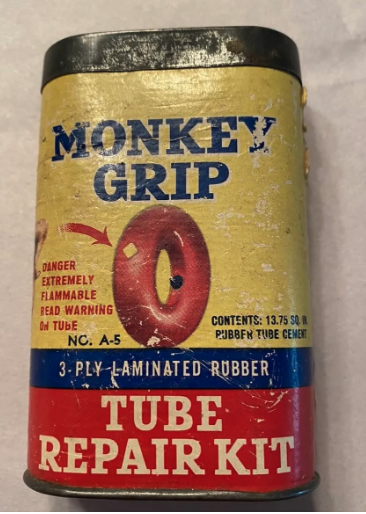
Monkey Grip patch kit - found on a facebook page
The patch was interesting. It was a diamond-shaped piece of metal with rubber on one side, and on the other side, the metal was turned down to hold a combustible material. We placed the rubber side centered over the puncture, and then slipped the patch, tire, and a piece of wood into a vise, and then closed it somewhat tightly. Grandpa then made a prick into the underside that was combustible and lit a match to it (or maybe used his burning cigar, which he frequently smoked). It would quickly start burning and heating up the rubber, and this would vulcanize the rubber to the tube. Grandpa warned me about it being hot, even though the process burned out quickly. Perhaps he suggested that we go in for some ice cream if it was a hot day, but I don't recall. We waited until it cooled, put the tube into the tire, placed the tire onto the wheel, and then put the wheel back on the bike. He may have first tested the quality of the patch by pumping up the tire before putting the wheel back on the bike; I now do that, especially on the back wheel, where the chain complicates things.
I know that I got several more flat tires on this bike before we moved to Fargo in August of 1968 (at age 10). Grandpa may have helped me some with the second (or even third), but I know that I did at least on my own before moving. I also felt competent in the process. Before leaving, I recall at once biking around the block. (Which, then, meant about a four-mile ride on gravel roads.) I would sometimes bike with my siblings or by myself, but never with friends since we were too far away from them. I do recall that at the end of school in one of my last years before moving to Fargo (likely spring 1968), I biked to Lincoln school one day. That was about 6 miles or so, but more than half was on a paved surface.
When I started fifth grade in Fargo, I soon realized that all my friends (of course, not all, but it seemed like it to me) had one of the (new-to-me) Stingray bikes.
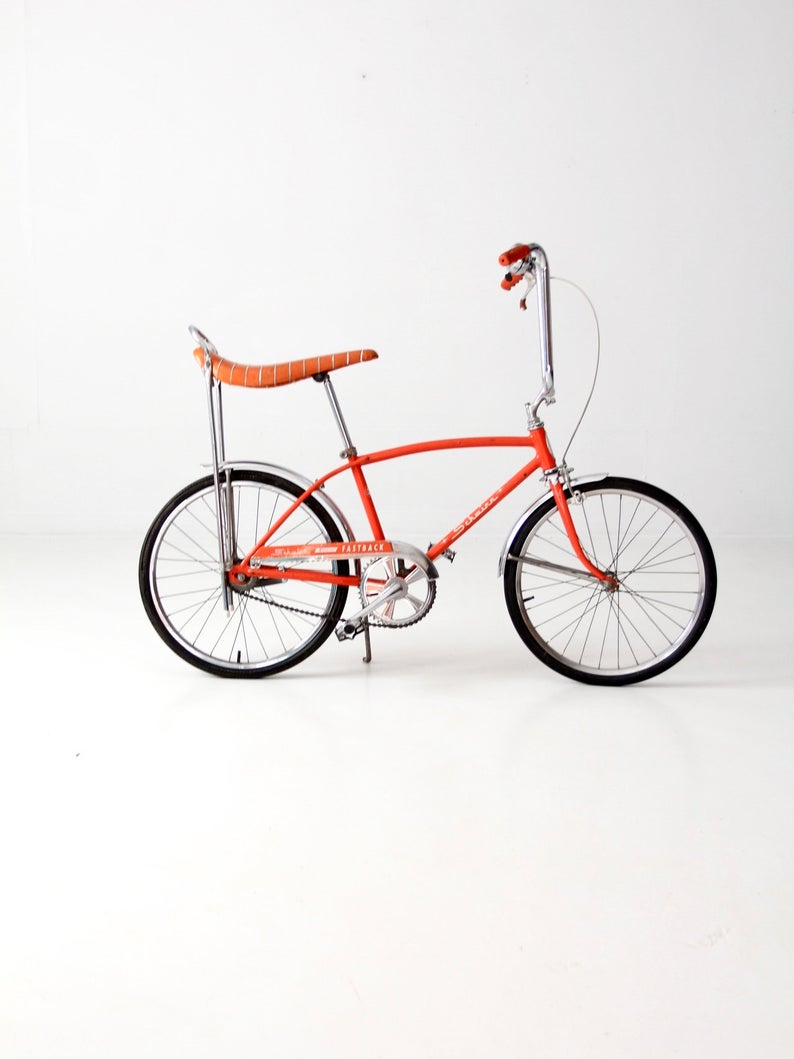
The cool Schwinn Stingray bike, modeled after motorcycles
I don't recall the details, but I think a neighbor got a new model of Stingray and I somehow bought (who paid?) his old one. At any rate, I liked this new bike, and it was so much easier to ride in Fargo since there were no gravel roads (though many cars). After putting some miles, either that first fall or the next summer (more likely the latter), I got a flat tire. I don't recall if we already had a tube repair kit or if I needed to buy one. I then began the process outlined above. However, when I put the tire on the bike and filled up the tube, I realized that I still had a flat tire. I thought that perhaps I erred in attaching the patch, but when I found the leak, it was not at the patch. So I fixed the new hole. This time, before putting the tube into the tire on the wheel, I first checked to make sure that both patches held and there was no leakage.
After putting the wheel back on the bike and pumping up the tire, I was ready to sail off. However, shortly after departing, my tire had a flat. How could that be, I thought. I had double-checked the tube before installing the wheel. So, back to square one, and I started over. I found the leak (a small slice, similar to the last one), patched it, tested it, and reinstalled the wheel. After starting out on the bike, I got ANOTHER flat. What is going on?
Each new flat tire resulted in a new puncture, so I was confident in my patching technique. I had tested the tube in water before installing the wheel, so I knew that my process was good up until the installation of the tire and the wheel on the bike. I knew that nothing could go wrong with putting the wheel on the bike, so some mistake must have happened while putting the tire on the wheel. I did it the same way as I had when I had done it near Grandpa's garage. Or had I? The only difference was that it was a different screwdriver to use as a lever to get the tire bead over the rim. As I thought about the difference was that my screwdriver was smaller and sharper while Grandpa's was larger and more blunt. And I recalled the punctures looking like little slits. (Of course, now I never use screwdrivers, but I use actual tire levers that are more blunt.)
With this in mind, I was more careful at the installation of the tire on the wheel by choosing a larger and more blunt screwdriver and tried to be more careful not pinch the tube or poke the tube with the screwdriver. Success came, and I FINALLY learned how do this process more carefully. At least now I no longer have self-inflicted flat tires.
Published 2026-01-22.
If you find any errors in the text, please let me know. Thanks. Contact me with errors or comments using hibbardac@gmail.com. [Back to the top] [About the author, Al]